Responding to climate impacts: Keeping buildings cool
UK summers increasingly featuring periods of very high temperatures. How can charities and community organisations help their staff, volunteers and service users stay cool?
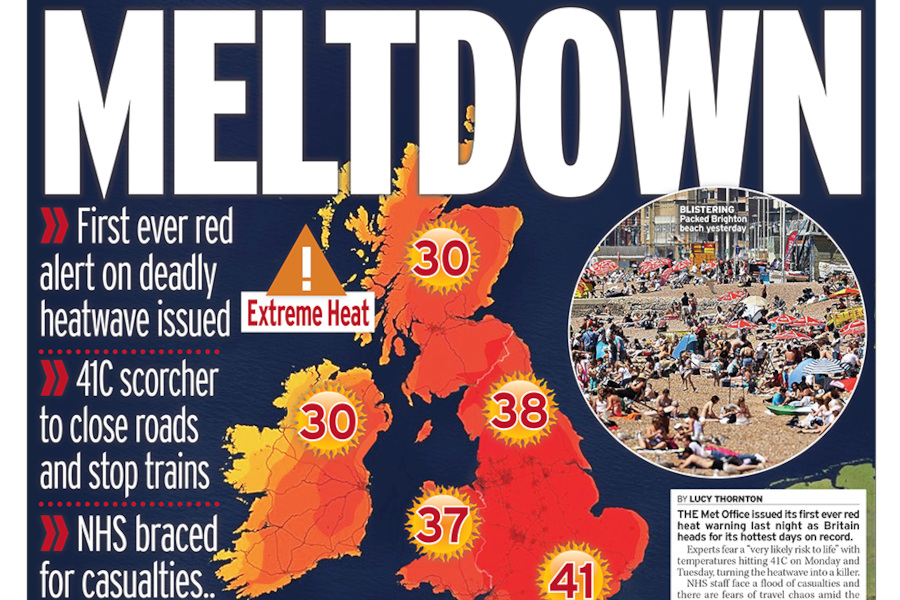
The Daily Mirror reports on the 2022 heatwave. In July, the Met Office issued its first-ever red warning for extreme heat. The Government declared a national emergency and later estimated that there were 2,985 excess deaths associated with heat episodes that year. (Photo: Bradford Timeline via Flickr CC BY-NC 2.0)
UK summers are getting hotter. The summer of 2022 saw temperatures above 40°C for the first time on record in the UK, and new national records set in England, Scotland, and Wales,
What's more, researchers at the University of Oxford have found extreme heat events – such as the record-breaking heatwave in 2022 – are likely to become more regular. Researchers found that the maximum temperature of the hottest days is increasing at twice the rate of the maximum temperature of average summer days. The results highlight the need for urgent action to adapt infrastructure to the impacts of climate change.
UK buildings are not designed for heat
Most UK properties are ill-equipped to deal with climate change. While large office buildings may have air conditioning, smaller buildings are unlikely to be designed to manage overheating. Smaller charities and community groups are more likely to be using buildings that are poorly insulated and not designed for extreme heat.
The obvious answer may seem to be to install air conditioning. But air conditioning uses a lot of energy and will add to your organisation's energy costs. Wall-mounted air conditioning units cost roughly £1,000 each, plus installation costs. Portable air conditioning costs less - around £500 - but will add significantly to electricity bills.
Twelve steps to cope with high heat in charity buildings:
The following points outline practical, low-cost actions which voluntary organisations can take to limit heat impacts during heat waves:
- Keep the sun out: keep blinds and curtains closed during the day.
- Keep the heat out: it may seem counter-productive to block breezes, but opening the windows will let more heat in. Keep windows shut during the day, particularly between 11am and 4pm.
- Ventilate when it is cool: Open blinds and windows when it is cool. Leaving windows open at night is likely to be a security risk. For offices that are empty outside working hours, the best time is likely to be early in the morning.
- Encourage airflow when it is cool: if your premises have windows on more than one side of the building, open all the windows to encourage air to move through the office.
- Encourage staff, volunteers and service users to keep hydrated: remind people about the importance of drinking enough when it is very hot. Ensure there is cool water available.
- Adjust working hours: if possible, consider letting employees start earlier and finish later. This will also help your charity team avoid a hot and sticky commute during peak hours.
- Turn off unnecessary electrical devices: every electrical device produces heat, contributing to the warming of your buildings. Turning off devices will also save money. If you still have traditional incandescent bulbs in your lights, switch them off where possible. Traditional light bulbs generate more heat than newer low-energy bulbs, and in smaller spaces, they can raise the temperature significantly.
- Switch off: at the end of the day, make sure all computers and screens are switched off.
- Reflect the heat: consider installing reflective solar or energy-control film that redirects sunlight away from the office. If film is impractical, consider placing large light-coloured items near sunny windows to reflect the heat away from the office.
- Review the layout: move desks away from direct sunlight and large electrical items such as photocopiers. If possible, avoid blocking cross-ventilation of spaces with tall pieces of furniture.
- Review the options for outdoor workers: people working outside will be at heightened risk of heat-related illnesses. Consider redeploying them during periods of extreme heat. Be aware that people in cities will be especially vulnerable to heat because of urban 'heat island' effects.
- If the building has air conditioning, ensure that all units are properly serviced. A poorly maintained system can increase the risk of respiratory tract infections, Legionnaire’s Disease, black mould spores and sick-building syndrome.
Bigger steps
1. When relocating to new premises, consider summer heat. Check the following:
- Are there large south-facing windows? These could cause solar gain during hot periods. Is there any form of external solar shading?
- Are there blinds and/or curtains? Can you install suitable sun-blocking blinds?
- Can you open the windows? Sealed or hard-to-open windows mean you have to rely on mechanical ventilation.
2. If you own your building, or can work with your landlord to improve your building, consider installing passive design sollutions such as insulation and external solar shading. (Passive systems involve designing buildings to naturally control temperature without mechanical aid.) For example, if your community building has inward-facing windows or sash windows, you could fit external shutters or slatted blinds on the outside of the building to reduce heat coming in.
3. If windows open outwards, consider installing an awning to provide shade.
4. Planting trees and enlarging green spaces may be a longer-term solution. Trees and shrubs can provide shading and reduce the temperature through evapotranspiration (the evaporation of water from the plant’s leaves to the surrounding atmosphere).