New push for charities to disinvest from fossil fuels
A new campaign aims to persuade charities to withdraw their investments from businesses involved in fossil fuel extraction.
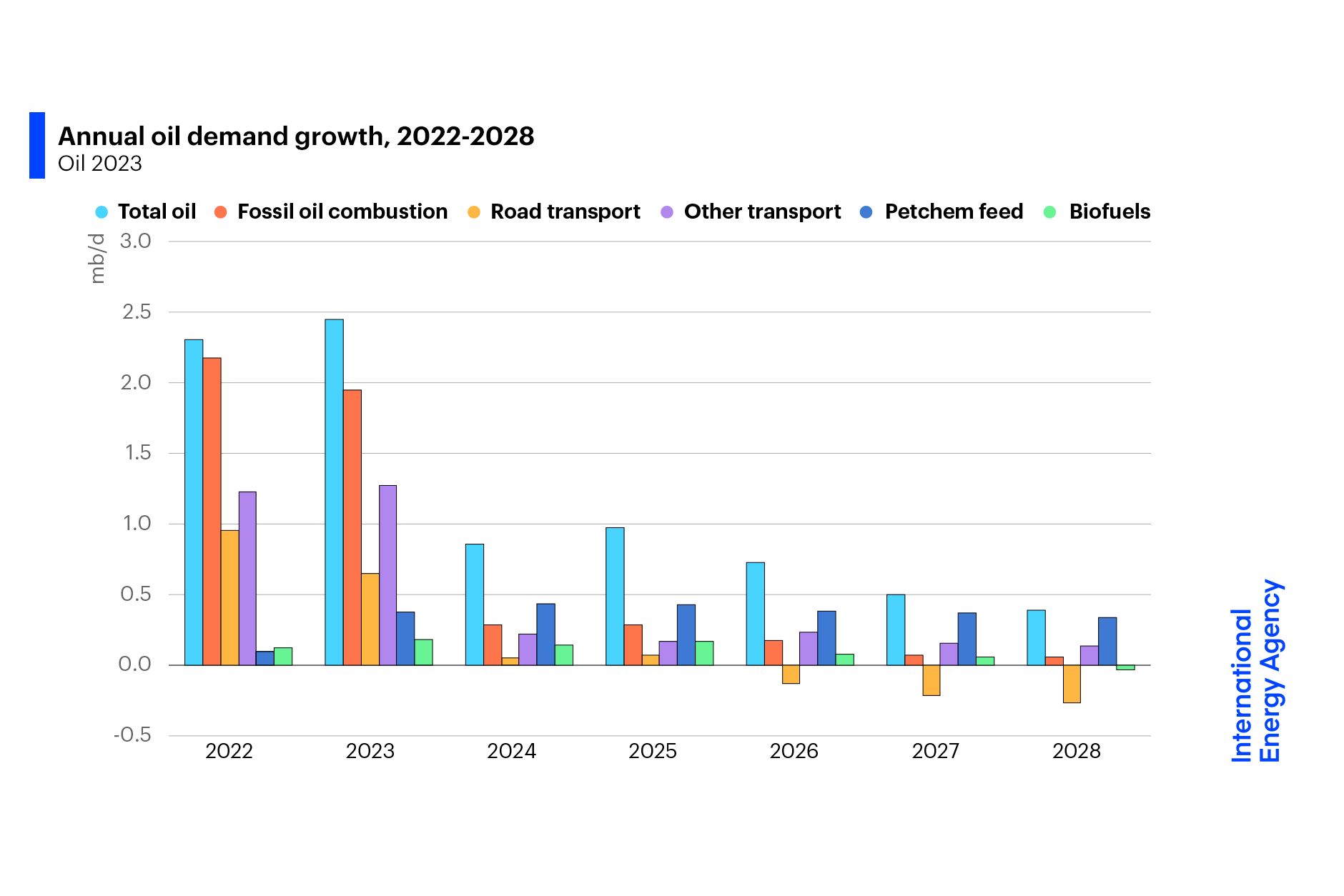
The International Energy Agency (IEA) predicts that global demand for il will slow significantly by 2028. (Source: IEA , Oil 2023, CC BY 4.0)
The National Council for Voluntary Organisations (NCVO) has launched a new campaign to encourage charities to divest from fossil fuel-related businesses. The campaign, called Fuelling Positive Change, aims to persuade voluntary sector organisations to withdraw their investments from businesses involved in fossil fuel extraction. This includes companies involved in the production, transportation, refining, and marketing of fossil fuels such as coal, tar sands, oil, and gas.
The NCVO says the initiative is driven by the recognition that fossil fuels are the main contributor to climate change.
The campaign follows a wider trend, with more than 1,500 institutions worldwide having committed to fossil fuel divestment. The Church of England recently decided to divest its £10.3bn endowment fund and £3.2bn pension scheme
High Court rues on charitable investments
Most charities choose to invest their funds to achieve the best financial returns, so that they can spend the income on delivering their charity’s purposes. Some charities also make social investments - where the investment itself helps to achieve the organisation's charitable purpose.
However, June 2022, the the UK's High Court ruled that the trustees can align their investments with their mission, even if this involves financial risk by excluding a large part of the potential investment market. The case was brought by two of the Sainsbury Family Charitable Trusts (the Ashden Trust and the Mark Leonard Trust) in order to establish on whether the charities could align their investments with the goals of the Paris Climate Change Agreement.
The High Court ruled that charity trustees also have discretion when making financial investment decisions to exclude certain investments based on non-financial considerations that are in the best interests of the organisation.
Oxford University's Faculty of law blog argues that the ruling is significant because it establishes that charitaby trustees have a wider latitude in determining a suitable investment policy than previously thought. The blog says: "There is increasing recognition that the way in which individuals and institutions allocate their investments is not value-neutral and can have substantial real-world effects, whether positive or negative. For this reason, we welcome the ruling as an invitation to charities to consider whether their purposes are best served by an investment strategy chasing the highest rates of financial return, and to develop their policies accordingly."
NCVO urges action
The NCVO argues that fossil fuel investments are unsustainable and pose significant reputational risks. NCVO's Director of influencing and engagement, Alex Farrow, said that although charities have already played a leading role in addressing climate change, more action was needed. He said the combined power of charitable investments could make a significant immediate impact.
The NCVO is asking charities to commit to divesting from fossil fuels within three to five years and to making no new investments in fossil fuels. The NCVO also wants charities that sign up to the commitment to publicise their decision to their donors, supporters and the wider public.
It says several charities have joined the campaign, including Christian Aid, Friends of the Earth, Save the Children, and Sense International. The NCVO has published various guides to help charities make the transition, including:
- A charity investment guide with step-by-step guidance for boards
- Guidance for fossil-free charities
- A glossary of climate, financial, and environmental terms, and
- A communications pack with templates and graphics.
The NCVO plans to host a series of events providing practical guidance on divestment.
The Chief Executive of the charity Sense, Richard Kramer, said there were practical benefits in supporting the campaign. He said Sense (formerly the National Deafblind and Rubella Association) aims to become carbon neutral by 2040 and that sustainable practices and ethical investment decisions align with Sense's charitable objectives.
Kramer also said that divestment offers other benefits to charities, including:
- Reduced energy costs in a volatile market
- Enhanced appeal to potential employees, particularly young staff
- Improved standing with donors and commissioners who increasingly consider environmental credentials
- Alignment with broader organisational values and commitments
The NCVO's campaign represents a significant push for the charitable sector to take collective action on climate change, recognising that environmental degradation will ultimately make charitable work more challenging across all areas of operation.
Challenges: difficulties for smaller charities and long-term effectiveness
The campaign materials implicitly acknowledge that divestment is more difficult for smaller charities. Many small charities and voluntary organisations don't have in-house financial expertise and can't afford to pay financial advisors. In fact, some small charities already report difficulties in accessing basic banking services. If they have any funds at all, these are likely to be in common investment funds.
Others argue that while divesting from fossil fuels may produce a 'feel good' effect, the shares sold will be purchased by other buyers, and few charities can stop using all services and products that depend on fossil fuels.
Scottish law firm Anderson Strathern suggests that long-term engagement is a more effective way to create change. A recent blog argues: "Avoidance and divestment have value as strategies for certain reasons, and so specific charities, but overall we believe engagement is the best way to change companies for the better."
The NCVO says long-term engagement has had a limited impact, pointing to the Church of England's long efforts to engage with the fossil fuel sector. The NCVO says the non-profit sector doesn't have enough power to secure significant changes through engagement, and with urgent action needed, slow and gradual advocacy is likely to produce too little, too late.
Instead, the NCVO argues, the divestment campaign can achieve impact through communication, by raising public awareness, making the case for government action and arguing for investing in solutions rather than the causes of climate change.