Installing solar panels on historic charity buildings
Historic buildings present specific planning, structural and technical challenges for installing solar panels. With the right approach, renewable energy and heritage conservation can be compatible.
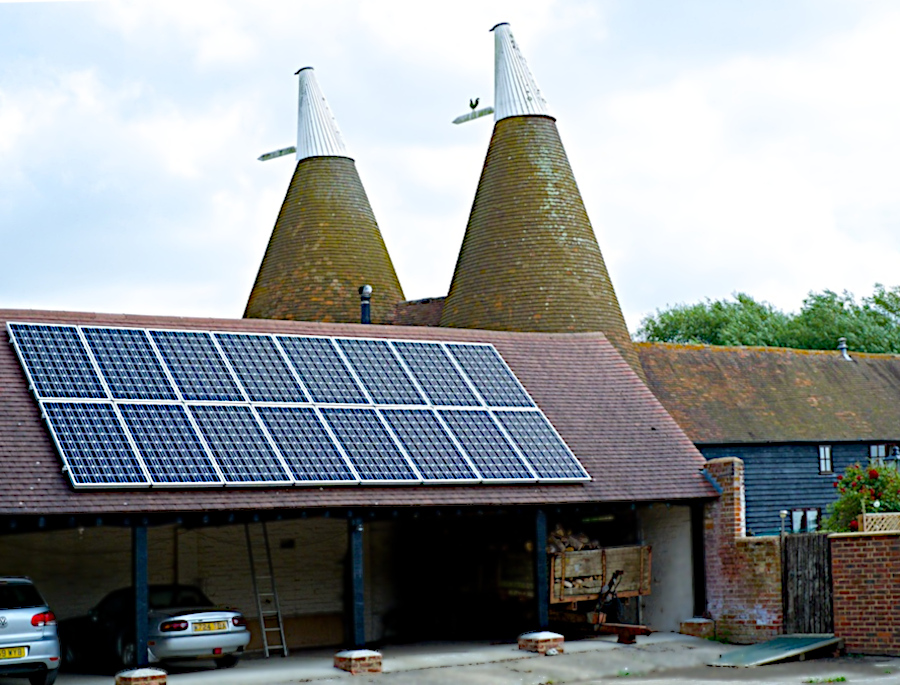
This double oast house in Kent has solar panels installed on the attached building. (Photo: Peter Synner via Wikimedia Commons, CC BY-SA 2.0)
Before deciding to install solar photovoltaic (PV) panels on an older building, you will need to consider a range of regulatory, structural and technical issues.
Conservation and planning
Historic buildings often have special legal protections, including listed building status. If your charity's building is listed, you will need to apply for Listed Building Consent from your local council. If you install panels on a listed building with prior consent, this is a criminal offence.
You may need to consult with local conservation officers to see whether your charity can get permission to install solar panels. They will want to see the details of your plans and be assured that the installation will not damage the historic fabric of the building. You will also need to apply for special planning permission for any associated construction work that may be required. In addition, any changes you make to your building must preserve the building's architectural integrity.
Older buildings that are not listed might be protected by being within a conservation area, and as such, may need planning permission for some alterations.
Visual Impact and aesthetic considerations
The solar panels should be minimally visible from ground level and street view. Some historic sites might require panels to be completely hidden from public view. You can improve the visual impact by using low-profile solar panels, panels that match the roof colour.
What are solar panels?
Roof-mounted solar panels can be "photovoltaic", in which the panels generate electricity or "thermal", which means the panels heat water. Solar photovoltaic roof tiles, also known as solar shingles or solar slates, are a relatively new technology that is more expensive but is rapidly getting cheaper.
Structural and technical considerations
Historic buildings may have weaker or older roof structures not designed to support the weight of solar panels. Your charity will likely need to get a detailed structural engineering assessment to determine the roof's load-bearing capacity and overall condition. You may need to reinforce the roof structure; this could prove expensive.
Most PV installations are installed over the existing roof covering by fixing the PV array to a set of rails fixed to the roof. You may be required to use a specialised mounting system that will not damage the building's historic fabric. The mounting and materials should not damage historic materials or any original architectural features. You may be required to use non-invasive fixing techniques that can be removed.
Historic England has useful guidance on issues related to structural load and fixing options for attaching solar pv on different types of roofs.
If your roof is not suitable for solar panels, ground-mounted solar arrays can be a good alternative, although some restrictions will still apply if your building is listed.
Energy Performance
The optimal roof location for solar panels is south-facing, with an angle of 30-40 degrees. Historic buildings often have less optimal roof orientations. The roof may be shaded by surrounding protected structures or trees.
Older buildings may come with technical challenges, such as complex roof geometries that are unsuitable for installing standard panel arrays. The panel positioning may need to be more complex to maximise energy generation.
Also note that you may need to review the building's electrical systems and wiring.
Use professionals with expertise in historic buildings
Trustees have a responsibility to protect the fabric of buildings held in trust, and to ensure that any works are properly consented and professionally managed.
When considering installing solar pv on a historic building, your charity may need to engage specialists with experience in historic building conservation. Each historic building will present unique challenges, and your organisation may need to employ professionals to undertake technical assessments.
The best route may be to aim for a positive collaboration with planners, conservation architects, renewable energy experts and installers.
Financial Considerations
All of these requirements may result in higher installation costs and a lower return on your charity's investment, compared to modern buildings.
On the plus side, you may find that your charity is eligible for historic building grants or renewable energy incentives.